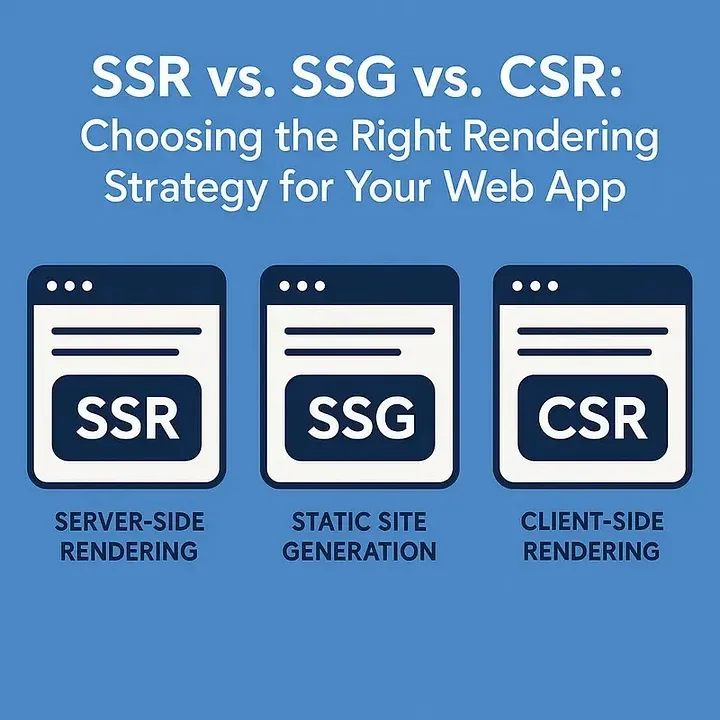
SSR vs SSG vs CSR: Performance & SEO Explained (2026 Guide)
Saptarshi C
April 8, 2026 • 3 min read
Learn the real difference between SSR, SSG, and CSR in terms of performance and SEO. Discover which rendering strategy to use for faster websites and better Google rankings.
SSR vs SSG vs CSR: What Actually Matters for Performance and SEO?
When building modern web applications, developers often debate between SSR (Server-Side Rendering), SSG (Static Site Generation), and CSR (Client-Side Rendering).
But here’s the reality:
It’s not just about performance SEO compatibility is equally critical.
You can build the fastest app in the world, but if Google can’t properly crawl it, your traffic will suffer.
Let’s break this down in a practical, real-world way.
Quick Comparison
Approach
Performance
SEO
CSR
❌ Slow initial load
❌ Weak / inconsistent
SSR
✅ Fast first paint
✅ Strong
SSG
🚀 Fastest
🚀 Best
CSR (Client-Side Rendering)
Most modern SPAs (especially Angular apps) default to CSR.
How it works:
Server sends a basic HTML shell
JavaScript loads and renders the UI in the browser
Performance Impact:
Slow First Contentful Paint (FCP)
Heavy dependency on JavaScript
Fast after initial load
SEO Impact:
Content is not present in initial HTML
Google can render JavaScript, but:
It’s delayed
It’s not always reliable
It may lead to indexing issues
This is why you often see:
“Discovered – currently not indexed”
Best Use Cases:
Dashboards
Internal tools
Authenticated SaaS apps
SSR (Server-Side Rendering)
SSR renders the page on the server for every request.
Performance Impact:
Faster initial load
Improved perceived performance
Depends on server response time (TTFB)
SEO Impact:
Fully rendered HTML is sent to the browser
Search engines can crawl content instantly
Better rankings and indexing
Best Use Cases:
Landing pages
Marketing pages
Dynamic public content
SSG (Static Site Generation)
SSG generates pages at build time and serves them via CDN.
Performance Impact:
Extremely fast (best FCP & LCP)
No runtime server cost
Highly cacheable
SEO Impact:
Fully crawlable static HTML
Instant indexing
Excellent for organic traffic
Best Use Cases:
Blogs
Documentation
Portfolio sites
What Actually Matters for Performance
Choosing SSR vs SSG vs CSR is only part of the story.
1. Bundle Size (Biggest Factor)
Even SSR apps can be slow if:
JavaScript bundles are huge
Optimize with:
Code splitting
Lazy loading
Tree shaking
2. Hydration Cost
Even with SSR/SSG:
JavaScript still hydrates the page
Heavy hydration = slower interaction
3. Network & Assets
Optimize images
Use CDN
Enable compression
4. Caching Strategy
SSR + caching ≈ SSG performance
Use:
CDN caching
Edge functions
Redis
SEO vs Performance: The Real Trade-Off
Scenario
Best Approach
Blog / content site
SSG
SaaS landing page
SSR
Dashboard
CSR
Real-World Strategy (Recommended)
The best approach in 2026 is hybrid rendering:
SSG → Blog & documentation
SSR → Landing pages
CSR → Dashboard / app
This is what most successful SaaS companies do.
Real Problem: Why Your Pages Are Not Indexed
If you're seeing:
“Discovered – currently not indexed”
Likely reasons:
Your site is CSR-heavy
Content is not in initial HTML
Google delayed JS rendering
Fix:
Convert key pages to SSR or SSG
Ensure content is server-rendered
Improve page speed
Common Mistakes
Using CSR for SEO pages
Assuming Google fully executes JavaScript
Ignoring hydration performance
Overusing SSR without caching
Final Thought
SSG = Best for performance + SEO
SSR = Best balance
CSR = Best for interactivity
Simple Rule
If it needs to rank → use SSR or SSG
If it needs to interact → use CSR